How to get a yes from your dream speakers for your conference
 Sacha Judd
When organizing a conference instinctively a lot of care is put into how we treat our attendees. After all they're the paying customers here and each conference needs them to survive. However, how you treat conference speakers is just as important, if not more important for the success and longevity of your conference. Let Sacha, an experienced conference speaker who has spoken at Velocity (San Jose), Webstock (Wellington), Beyond Tellerrand (Berlin, Dusseldorf), the Mozilla Festival (London), FFconf (Brighton) and Sunrise (Sydney), tell you why.
At the very first conference I ever spoke at, I attended the speakers’ dinner the night before, feeling a little bit out of my depth. One of the things that surprised me was that most of the other speakers already knew each other. They’d been at other events together, and they were looking ahead to the next conferences they’d be travelling to. And one thing really stood out. They had strong opinions about which events were worthwhile and which ones should be avoided. When I said that I’d be speaking at Webstock in Wellington in a few months’ time, it was received with a kind of hushed awe – that was an event where everyone knew the speakers were treated extremely well.
Since then, I’ve been fortunate to speak at some truly great events for speakers. Where I’ve been met at the airport, taken to a good hotel, and welcomed warmly. The tech check happens, calmly, in plenty of time. And when I walk on stage I have exactly one job left to do.
I've also done the other version. A 30-hour journey with nobody at the other end and a schedule that changed on Tuesday. A "quick" sponsor meet-and-greet ten minutes before you go on. And on one horribly memorable occasion, being told that I needed to make posters to advertise my own talk and hang them around the venue, or no one would come. Catch me trying to find a print shop open on a weekend near London Bridge. My room was still mostly empty – never again.
A speaker who feels looked after takes risks up on stage — tries new material or tells a vulnerable story and gives you the talk they couldn't give anywhere else. A speaker who's spent the morning chasing logistics gives you the safest version and they’re going to be checked out. So, from someone who's been on a lot of stages: here's what it looks like to be great to your speakers, in the order it happens.
The invitation
If you have a call for proposals, make that clear on your website, and be detailed about your process. There’s nothing worse as a speaker than firing in a proposal and hearing nothing. Say what your deadlines are, and when you’ll be making a decision. The best CFPs also describe the kinds of talks and topics you’re looking for so I know if I’m a fit.
If you’re inviting speakers personally, then tell them why. Every speaker can instantly distinguish a personal invitation from a mail merge. Tell them about your audience, the size of the room, who else is on the bill, what you're hoping they'll bring that nobody else can. You're commissioning a piece of work so you should brief it like one.
And have the money conversation first, plainly, in the first email. Fee, travel, accommodation — whatever the package is, say so before anyone has invested in the idea of coming. And always, always pay your speakers something. The number of times I’ve been invited to give a talk, and been told there’s “no budget for speakers”, but there’s an afterparty planned, is mind-boggling. To be clear, if you have a budget for drinks, then you do have a budget for speakers, you’re just not choosing to spend it on them. A new conference talk is weeks (months) of work. No one is doing it for “exposure”.
Be clear about the diversity of your lineup, and the code of conduct for the event. I don’t want to say yes, and then find that I’m on a line-up composed entirely of beardy white dudes. And I won’t attend an event that doesn’t take its code of conduct seriously.
Before the event
Give your speakers one human point of contact who answers email. Not a shared inbox or a portal, an actual person.
Lock the format early — talk length, Q&A or no Q&A, recording arrangements — and then don't change it the week before. Send the AV details up front: screen ratio, connection types, confidence monitor or not, clicker provided or bring your own.
And please, please, stop demanding the final slide deck two weeks in advance. I understand the impulse — you want to know the talk exists, you want to load everything onto one machine. But a talk is a living thing right up until the moment it's delivered. My deck has my typefaces in it, which your conference laptop does not. It has changes I will be making on the plane, in the hotel, and possibly backstage, because something happened in the news that morning or because the speaker before me made my third point better than I do. A deck frozen a fortnight out is a talk delivered at fortnight-old room temperature. If you need reassurance the talk is real, ask for an outline, a tech rehearsal, anything — but let speakers present from their own machines if they want to.
If you want speakers to promote the event, make it optional and make it effortless — pre-written posts and good images and their actual session link. Ultimately my job is the talk. Marketing is yours.
At the event
Make sure one of your welcome team knows the speakers’ names, their dietary requirements, and when their tech check is. Make sure the tech check actually happens — unhurried, the day before if possible, with the actual equipment in the actual room.
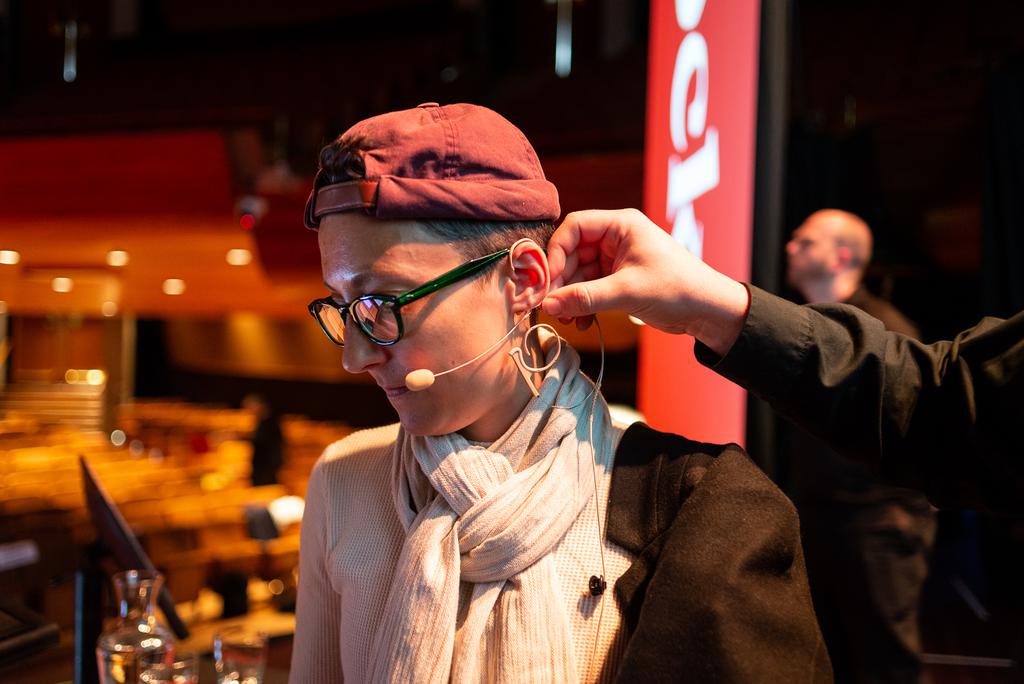
A word about that equipment. I have lost count of the AV setups that simply cannot handle a woman in a dress. The standard rig assumes a belt and a breast pocket: a transmitter pack clipped to a waistband my dress doesn’t have, a lapel mic threaded through a collar I'm not wearing. What follows tends to be an improvised backstage pantomime which has involved my bra strap, and a sound tech apologising into my shoulder blade. It's 2026 – Love Island manages to mic contestants in bikinis. Ask speakers in advance what they're wearing or what mic they prefer, and have options ready — headset mics, mic belts, a handheld on a stand. Half your lineup should not have to dress around your audio equipment.
Give speakers a green room that's a sanctuary rather than a storage cupboard with a kettle. Feed them — speakers routinely miss every catered break because they're being lovely to people, and then go on stage running on adrenaline and a protein bar. And protect their time: a speaker who has been "just quickly" introduced to forty sponsors before their slot has nothing left for the room and the room is what everyone paid for.
Then there's the speakers' dinner, which I'd argue is the most underrated line in any conference budget. It doesn’t have to be fancy or expensive, but put your speakers around a table the night before. If we get a chance to talk to each other, we stop being a list of headshots and we become a cast. We watch each other's talks. We reference each other on stage. The audience can feel that warmth.
On stage and after
Ask speakers how they'd like to be introduced, then introduce them that way — an MC improvising from a half-remembered LinkedIn page is awful. Know how to pronounce our names. Have the MC manage time and Q&A so the speaker doesn't have to police the room mid-thought. Ideally though, don’t do Q&A. It’s hardly ever valuable, and keen beans can always come and find a speaker to ask a question in a break.
Afterwards: share the recording promptly, and be clear about who can use it and how. Pay the invoice without requiring three chasing emails — nothing curdles a lovely event faster than spending two months as your own debt collector. And send a thank-you that proves a human watched the talk. One specific sentence about what landed is worth so much to someone who has poured themselves into a talk.
Why this is worth it
Because speakers talk to each other. Constantly. We compare notes on flights and fees and whether the tech check happened, and certain conferences develop a gravitational pull — the lineup you dream of starts saying yes before you've finished asking, and saying it for less than you'd expect, because they know they'll be looked after.
That reputation costs almost nothing to build. Most of what's on this list is care and forethought rather than budget. The events I'd return to in a heartbeat are simply the ones where someone thought about me before I arrived — and every organiser reading this can pull it off.

Sacha Judd
As a well-known expert on the power of fandoms, Sacha has spent the last decade speaking about the intersection of the tech sector and fan communities at conferences around the world, and in-house at companies including Slack, Sky TV UK, Twilio and Twitter.
Sacha writes a weekly newsletter called What you love Matters, and is the co-founder of Lume Music.